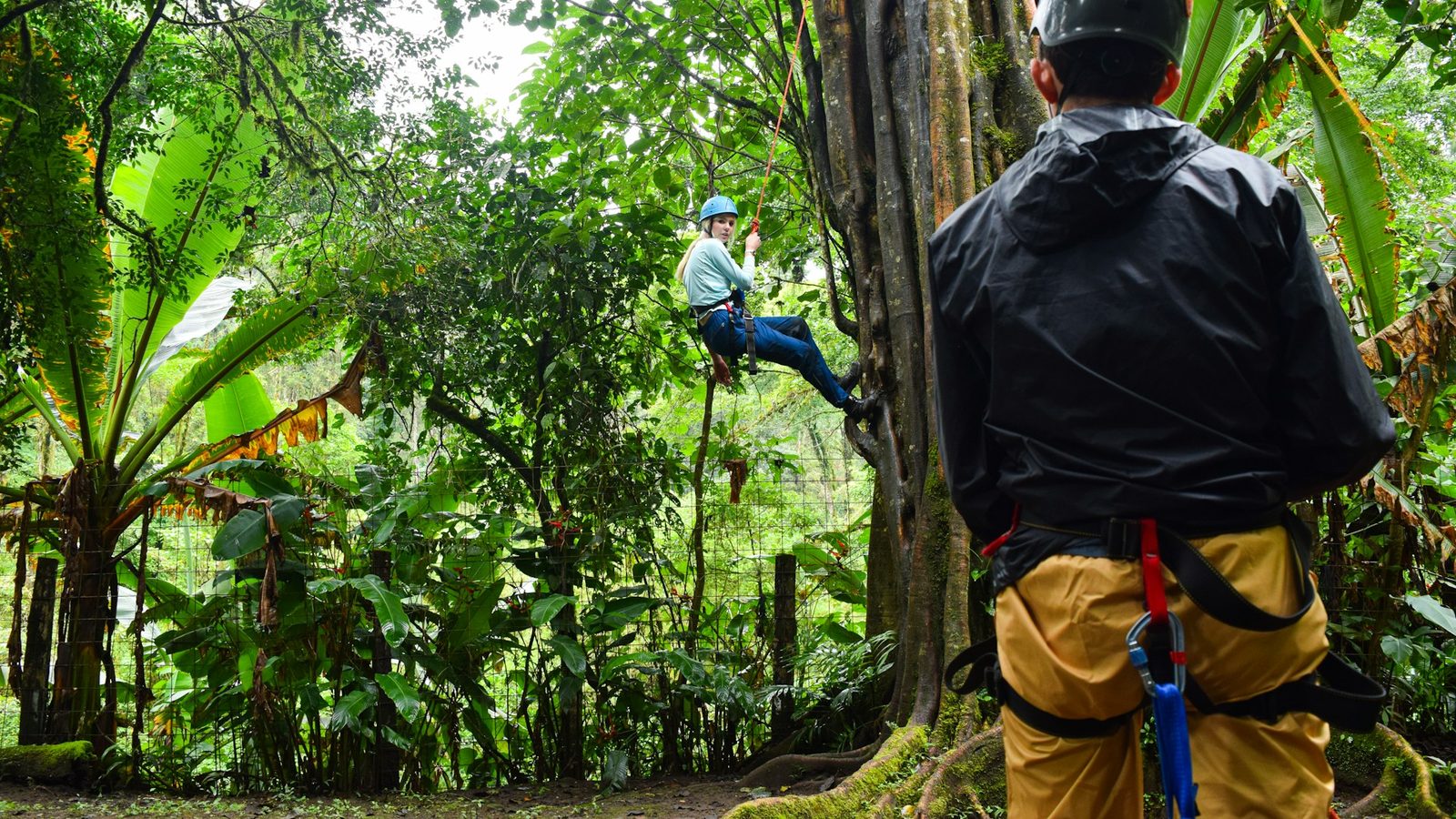
Costa Rica covers 0.03% of Earth's land area, but its national parks host roughly 5% of all animal and plant species on the planet. A naturalist guide is the person who leads groups along the trails of Corcovado, Monteverde or Manuel Antonio, sees things a tourist wouldn't notice in a week, and turns the jungle into a story you can actually follow.
What the specialist does
Leads groups along the trails of national parks and reserves, spots sloths, quetzals, jaguarundis and morpho butterflies, explains animal behaviour, ecology and the connections between species. Works in partnership with lodges, eco-tour operators, or independently.
Entry-level salary
Starting out, 1100–1400 € net per month including tips (base pay is modest, around 700–900 €, but in popular parks tips double the income). That's roughly in line with the country's average salary – around 1100–1200 € net . In Manuel Antonio or La Fortuna, renting a room for 320–410 € fits comfortably; in San José the same salary is already tight.
Salary after 3–5 years
1800–2500 € net, if you go freelance with private tours or specialise in birds (birding tours pay noticeably more). The top guides in Corcovado and Monteverde charge 180–280 € per day of work.
How to train
ICT certification is mandatory for legal work . The Guía Naturalista programme at INA (Instituto Nacional de Aprendizaje) or private schools like ICETUR – around 1000 hours of theory and practice, takes 9–12 months, costs roughly 550–1100 € (payable in monthly instalments).
Language and special skills
Spanish B1+ for paperwork and dealing with locals. English B2+ is essential: about 80% of clients come from the US and Canada. Basic ornithology, zoology, botany. A Wilderness First Aid certificate significantly improves your hiring odds.
Demand
Tourism accounts for about 8% of Costa Rica's GDP, the country receives around 2.5 million tourists a year, and almost all of them want to visit a national park. ICT actively supports certified guides as part of its sustainable tourism strategy, and demand is stable year-round with a peak from December to April.
Visa and route for foreigners
Non-citizens of Costa Rica need a work permit through an employer (a lodge or tour operator), which must prove that no local guide with the relevant specialisation could be found. Processing takes 6–9 months, and the result is a DIMEX residence card. The alternative is the Rentista residency (proven external income of around 2300 € per month ) followed by ICT certification.
The big myth: "Guides in Costa Rica are just part-time students working for peanuts." In reality, a certified naturalist guide is a licensed profession with a state exam, and experienced guides in Corcovado or Tortuguero live no worse than the office middle class in San José. Tips from North American tourists genuinely feed a family.
What makes Costa Rica special is the concentration of biodiversity. In an area smaller than Switzerland live around 900 species of birds, 200 reptiles, 150 amphibians, and over 500,000 species of insects. In Corcovado alone you can see four species of monkeys, sloths, anteaters and a tapir in a single day – more than in most African countries during a week of safari.
Standard route for a foreigner:
→English B2 and Spanish A2 in 6–12 months
→tourist visa and choosing a region (Monteverde, Manuel Antonio, Corcovado, La Fortuna)
→Guía Naturalista course at INA or ICETUR (9–12 months)
→passing the ICT exam and getting your carnet de guía
→offer from a lodge or tour operator and applying for a work permit
→DIMEX and legal employment
The honest downside: seasonality and physical strain. From May to November the rainy season hits, tourist flow drops by 40–50%, and many guides scale back to 2–3 tours per week. Plus 6–8 hours a day on the trail at 90% humidity surrounded by mosquitoes – your body will not thank you in the first year. But by year three you can identify 200 bird species by voice alone and never want to go back to an office.